Introduction: Is SEO really dead?
No, SEO is not dead in 2026. But the way people search has changed a lot, and old SEO tricks alone don’t work anymore.
Today, you type a question on Google and often get an AI answer at the top. You ask ChatGPT for “the best SEO agency in Mumbai,” and it gives you names directly. Many people get their answer without clicking any website at all.
So business owners are asking a fair question: if people stop clicking, why spend money on SEO?
In this guide, we explain every big change in simple words. For each one, you’ll learn:
- What it is: the change in plain language
- How it works: what happens behind the screen
- The benefits: how it can help your business
- The side effects: what can hurt your traffic
Then we cover what has not changed, and what Indian businesses should do now.
Change 1: Google AI Overviews and AI Mode
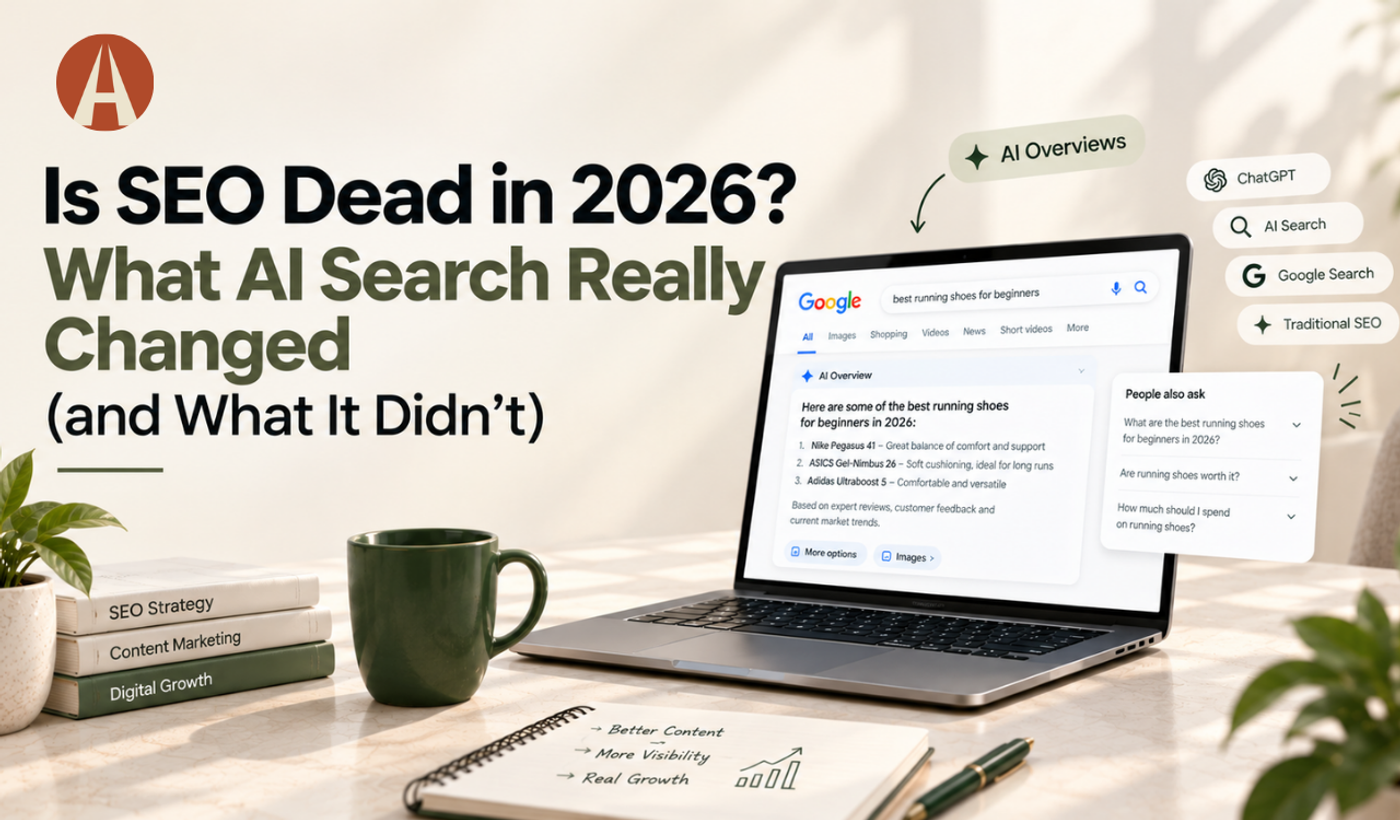
What it is: An AI Overview is the short AI-written answer that appears at the top of Google, above the normal blue links. AI Mode is a separate chat-style tab in Google where you can ask long questions and follow-ups, like talking to a chatbot.
In India, Google launched AI Mode in June 2025. In October 2025 it added seven Indian languages, including Marathi, Tamil and Bengali. Google said AI Mode crossed 1 billion monthly users by I/O 2026.
How it works:
- You type a question into Google.
- Google’s AI (Gemini) reads many web pages that already rank well.
- It writes one short summary answer.
- It shows small links to the pages it used as sources.
AI Mode goes further. It splits your question into many smaller searches, runs them all at once, and joins the results into one answer.
Benefits for your business:
- If your page is used as a source, your brand appears at the very top of Google, even above position 1.
- People who click from an AI answer usually already understand the topic, so they are more ready to buy.
- Being cited builds trust, because Google is “recommending” you.
Side effects:
- Fewer clicks. A 2026 SparkToro study found AI Overviews appear on more than 20% of Google searches, and clicks drop by nearly 60% when they show.
- Simple “what is” blog posts lose the most traffic, because the AI answers them directly.
- Ranking #1 is no longer enough if the AI answer pushes your link below the screen.
Change 2: ChatGPT, Gemini and Perplexity as search engines (GEO)
What it is: Many people now ask AI chatbots instead of Google. “Which CA firm in Navi Mumbai is good for GST filing?” goes straight to ChatGPT or Perplexity. Getting your business mentioned in these AI answers is called GEO (Generative Engine Optimization).
How it works:
- The chatbot searches the web (or uses what it already learned) to find information.
- It looks for clear, trusted sources: websites, reviews, directories, news, Reddit and LinkedIn posts.
- It picks brands that are mentioned often and described clearly.
- It writes one answer, sometimes with links to its sources.
In simple words: the AI recommends businesses that the internet already talks about.
Benefits for your business:
- A small business can get recommended next to big brands, if its information is clear and trusted.
- Leads from AI are often warm. The AI has already “pre-sold” you before the person visits.
- Perplexity and similar tools show sources clearly, so cited sites can still get good clicks.
Side effects:
- You can’t fully control what AI says about you. It may show old prices, wrong services, or a competitor’s name.
- AI traffic is hard to measure. Many visits show up in analytics as “direct” instead of “ChatGPT”.
- If your brand has few reviews or mentions online, AI may simply ignore you.
Change 3: Zero-click searches
What it is: A zero-click search is when someone searches on Google, gets the answer on the results page, and leaves without clicking any website. Think of checking a cricket score, a word meaning or a shop’s timings.
SparkToro’s 2026 study found that 68% of US Google searches ended without a click from January to April 2026, up from about 60% in 2024. India-specific numbers aren’t published, but the trend is the same.
How it works:
- Google shows the answer directly: AI Overviews, featured snippets, maps, “People also ask” boxes.
- The searcher’s question is solved on Google itself.
- If they need more, they search again on Google instead of visiting a site.
Benefits for your business:
- Your brand can still be seen even without a click. Your name, rating and phone number in the Google Maps listing do the selling.
- The people who do click are more serious. They want details, prices or to book, so they convert better.
- Some searches still send lots of clicks. The same study notes branded searches, local business searches and “ready to buy” searches are less affected.
Side effects:
- Total website traffic can fall even when your rankings stay the same.
- Traffic numbers alone can make SEO look like it’s failing, when it is actually still bringing leads.
- Blogs that only answer basic questions lose most of their visits.
Change 4: The flood of AI-written content
What it is: Anyone can now write 50 blog posts in a day using AI tools. So the internet is full of articles that look similar and say the same generic things.
How it works:
- Businesses use AI to write blogs, product pages and service pages quickly.
- Most of this content repeats what is already online.
- Google and AI chatbots get thousands of near-identical pages for every topic.
- They start preferring pages that show real experience, original data or a clear expert voice.
Benefits for your business:
- AI tools save time on research, outlines, meta descriptions and first drafts.
- Small teams can publish regularly without a big content budget.
- If you add your own experience, real photos, local examples and client results, you stand out easily, because most competitors don’t.
Side effects:
- Generic AI content rarely ranks and is rarely cited by AI answers.
- Publishing lots of low-quality pages can pull down the quality of your whole website.
- Wrong facts in AI-written content can damage your brand’s trust.
What did NOT change (the SEO basics still win)
Here’s the good news: AI answers are built from websites that already rank well. Google says AI Mode builds on its normal ranking systems. So strong SEO is still the entry ticket to AI search.
1. Technical SEO
- What it is: Making sure Google and AI bots can find, open and read your website.
- How it works: Fast pages, mobile-friendly design, clean URLs, a sitemap, no broken pages, and schema markup that labels your content (services, FAQs, reviews).
- Benefits: Your pages get crawled and understood faster, by Google and by AI tools.
- Side effects (if ignored): A slow or broken website is skipped by both Google and AI, no matter how good the content is.
2. Helpful, expert content (E-E-A-T)
- What it is: E-E-A-T means Experience, Expertise, Authoritativeness and Trust. It’s how Google judges if content comes from someone who knows the subject.
- How it works: Author names, real examples, case studies, original numbers, clear answers to real customer questions.
- Benefits: Expert content ranks better and gets picked as a source in AI answers.
- Side effects: It takes more time and effort than copy-paste or pure AI content.
3. Local SEO
- What it is: Showing up when people nearby search, like “dentist near me” or “interior designer in Panvel”.
- How it works: A complete Google Business Profile, correct name, address and phone everywhere, real reviews, and local pages on your site.
- Benefits: Local searches still bring calls, visits and direction requests, even without a website click.
- Side effects: Fake or inconsistent details, or ignored bad reviews, can hurt you on Google and in AI answers.
4. Backlinks and brand mentions
- What it is: Other websites linking to you or talking about your business.
- How it works: Google sees links as votes of trust. AI tools notice which brands are mentioned often across the web.
- Benefits: More trusted mentions mean better rankings and more AI recommendations.
- Side effects: Buying cheap spam links can get your site penalised. Quality beats quantity.
SEO vs GEO vs AIO: a quick comparison
These are not three separate jobs. GEO and AIO sit on top of good SEO.
SEO
AIO
GEO
Full form
Search Engine Optimization
AI Optimization (for Google AI Overviews and AI Mode)
Generative Engine Optimization
Goal
Rank in Google’s normal results
Get cited in Google’s AI answer
Get mentioned by ChatGPT, Gemini, Perplexity
What you get
Clicks to your website
Brand at the top of Google, fewer but warmer clicks
Recommendations and warm leads
Main work
Keywords, technical fixes, content, links
Clear direct answers, FAQs, schema, expert content
Brand mentions, reviews, clear business info everywhere
How to measure
Rankings, Search Console clicks
Whether you appear in AI Overviews for key searches
Testing what AI tools say about your brand
What Indian businesses should do now: a simple checklist
You don’t need to start over. Start with these steps, in this order:
- Fix your website basics. Check speed, mobile view and broken pages in Google Search Console.
- Complete your Google Business Profile. Add photos, services, timings and reply to every review.
- Answer real customer questions. Write clear, direct answers in the first 2–3 lines of each page. AI likes short, clear answers.
- Add FAQ sections and schema markup. This helps Google and AI understand your page.
- Show real experience. Add case studies, client results, team names and photos instead of generic text.
- Get mentioned in more places. Local directories, industry websites, LinkedIn, news and podcasts.
- Keep your details the same everywhere. Same name, address, phone and services across every platform.
- Test what AI says about you. Ask ChatGPT, Gemini and Perplexity: “best [your service] in [your city]”. Note who appears.
- Measure leads, not just traffic. Track calls, form fills and WhatsApp enquiries. Fewer visits can still mean more business.
Need help? At Altor Studio, we run SEO that’s built for AI search too: technical fixes, content and local SEO for Indian businesses. Get a free SEO and AI visibility check →
Frequently asked questions
Is SEO dead in 2026?
No. SEO has changed, not died. AI answers on Google and ChatGPT are built from websites that rank well and are trusted. Good SEO is now the base for showing up in AI search too.
Will AI replace Google search?
Not fully. Google itself now includes AI answers through AI Overviews and AI Mode. People still use normal search for local businesses, shopping and brand searches.
What is the difference between SEO and GEO?
SEO helps you rank in Google’s normal results. GEO helps your business get mentioned inside AI answers from tools like ChatGPT, Gemini, and Perplexity. GEO works best when your SEO is already strong.
Why is my website traffic going down even though my rankings are the same?
More searches now end without a click, because Google shows the answer directly. Check your leads, calls, and enquiries too, not just traffic.
Is SEO still worth it for small businesses in India?
Yes, especially local SEO. Searches like “near me” and “best [service] in [city]” still bring calls and visits. These searches are less affected by zero-click behaviour.
Can I use AI to write my blog posts?
Yes, for drafts and ideas. But add your own experience, real examples, and checked facts before publishing. Plain AI content rarely ranks or gets cited.
Conclusion: SEO isn’t dead; it grew up
SEO in 2026 is not about stuffing keywords or chasing more traffic. It’s about being the business that Google, ChatGPT, and your customers trust most.
AI changed where people find answers. It did not change what earns trust: a fast website, honest expert content, good reviews and a brand people talk about. Businesses that build these now will win both in Google and in AI search.
Ready to make your business visible in Google and AI search? Altor Studio helps Mumbai and Indian businesses with SEO, local SEO, and AI search visibility. Book a free consultation →